
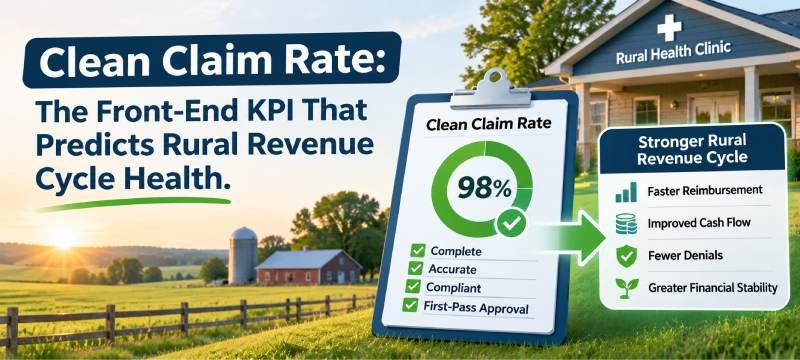
Most rural finance leaders closely watch denial rates and days in accounts receivable, but both are lagging indicators. By the time a healthcare claim denial posts or an account ages past 90 days, the error that caused it happened weeks earlier, usually before the claim ever left the building.
Clean claim rate measures that earlier moment. It tells a Critical Access Hospital (CAH), Rural Health Clinic (RHC), or Rural Emergency Hospital (REH) how many claims are ready to go out the door without anyone touching them. When the clean claim rate falls, denials and A/R days follow.
For rural providers, the KPI has a catch. A clean claim rate that looks healthy can mask returned Medicare claims, overridden edits and Method II professional lines that never reached the payer. Getting value from the metric starts with measuring it correctly.
What Is Clean Claim Rate?
Clean claim rate is the percentage of claims that pass all claim edits without manual intervention. The Healthcare Financial Management Association (HFMA) defines it in its MAP Keys as claims that pass edits with no manual intervention, divided by claims accepted into the claims processing tool for billing [1].
The definition includes primary, secondary and tertiary claims and excludes print-and-mail and Medicare shadow claims [1]. In plain terms, the numerator counts only claims your team never had to stop and fix.
A clean claim rate is not the same as a payer’s “clean claim”
Payers use the phrase “clean claim” differently. For Medicare, a clean claim is one that does not require the contractor to investigate or develop it outside its own operation before payment, and interest applies to clean claims not paid within 30 days of receipt [2]. Federal Medicaid rules require state agencies to pay 90% of clean practitioner claims within 30 days and 99% within 90 days [3].
Those definitions govern how fast a payer must pay. Clean claim rate as a KPI measures how often your own front-end and coding processes produce a claim that needs no correction. The two are related but should not be confused in reporting.
Why Clean Claim Rate Predicts Downstream Performance
Every claim that fails an edit enters a correction queue, adding to unbilled dollars and increasing days in A/R. Claims that slip through with errors fare worse: they come back as rejections or denials and must be worked again. HFMA has reported estimates that reworking denied claims can consume as much as 20% of revenue cycle expenses, because a denied claim costs roughly four times as much to process as the original [4].
The pressure is growing. In Experian Health’s 2025 State of Claims survey, reported by Fierce Healthcare, 68% of providers said submitting clean claims was harder than a year earlier, and 54% reported more claim errors. Missing or inaccurate data was the top cause of denials, cited by 50% of respondents [5].
Hospital leaders already treat the relationship between these numbers as a signal. An HFMA Pulse Survey reported by TechTarget found that nearly 80% of hospitals measure the difference between clean claim rate and initial denial rate [6]. When that gap widens, the scrubber passes claims that payers still reject, meaning edits are missing or outdated.
For a rural facility with a small business office, a handful of stuck claims can represent a meaningful share of a month’s revenue.
The Rural Measurement Gap: Where Clean Claim Rate Goes Wrong
The most common problem with clean claim rate in rural settings is not a low number. It is a misleading one.
Returned Medicare claims never show up as denials
Medicare Part A claims that fail front-end edits are returned to the provider (RTP) rather than denied. RTP claims are not considered filed, so the timely filing clock keeps running until they are corrected and resubmitted [7]. Because they are never adjudicated, RTPs do not appear on a remittance or in a denial rate.
HFMA’s related MAP Key for days in final billed not submitted to payer (FBNS) explicitly includes claims rejected, but not denied, during submission [1]. Facilities that track only remittance-based denials can miss an entire category of front-end failure.
Recent Method II editing shows how quickly RTP volume can build. Medicare implemented edits in July 2025 that return Method II CAH professional claims when the practitioner’s reassignment to the hospital is not on file. According to Medicare contractor CGS, the edits were temporarily deactivated from August 2025 to January 2026 because of RTP claim volume, then deactivated again in March 2026 until further notice [8]. A CAH measuring only denials would have seen none of that disruption in its KPI.
Blended rates hide the claims that matter
A facility-wide clean claim rate averages together very different claim streams. A CAH may bill inpatient, outpatient, swing-bed and Method II professional services on separate bill types, and an RHC bills on type of bill 71X under its own revenue code rules. When high-volume, low-complexity claims dominate the denominator, a failing low-volume stream disappears inside a respectable average.
Overridden edits inflate the number
If staff can release a claim past a hard edit without the system logging it as manual intervention, the claim counts as clean when it was not. A credible clean claim rate depends on scrubber settings that record every touch.
Building Rural Billing Rules Into the Measurement
A clean claim rate is only as useful as the edits behind it. National scrubber libraries are built for high-volume hospital and physician billing, so rural providers need edits that fail claims for the reasons their payers will.
RHC visit and modifier logic
CMS requires RHCs to report modifier CG on one revenue code 052X and/or 0900 service line per day, and that line carries the charges subject to coinsurance and deductible for the visit [9]. CMS also limits RHCs to one service line per day with revenue code 052X and a qualifying medical visit, with modifier 59 used when a subsequent, unrelated medical visit occurs the same day [10]. Qualifying mental health visits are billed separately with revenue code 0900 [10].
Each rule translates into an edit: CG on exactly one qualifying line per revenue code group, no duplicate 052X qualifying lines without a valid exception, and correct medical versus mental health revenue codes. With those edits in place, failures show up in clean claim rate before the MAC sees them.
Revenue code and bill type pairing
Under Method II, CAHs bill professional services on bill type 85X using revenue codes 096X, 097X, or 098X, with payment based on the Medicare Physician Fee Schedule [11]. RHC visits belong on 71X with 052X or 0900 [10]. Edits that validate these pairings protect the KPI from counting a claim as clean when it will be returned for a structural mismatch.
Enrollment and reassignment checks before billing
CMS notes that practitioners reassigning benefits to Method II CAHs can submit their applications through PECOS [12]. Comparing each rendering and attending NPI against the facility’s reassignment roster before the claim is released turns an enrollment gap into a visible edit failure rather than an invisible RTP.
Code transitions
Effective October 1, 2026, RHCs bill individual HCPCS codes for distant site telehealth services instead of G2025, while continuing to report modifier 93 for audio-only and modifier 95 for audiovisual services [13]. Every transition like that needs a matching scrubber update, or the clean claim rate will overstate readiness until the returns arrive.
How to Measure Clean Claim Rate in a Rural Setting
- Adopt the HFMA definition and document it. Use the MAP Keys numerator and denominator, and write down any local adjustments so the measure means the same thing every month [1].
- Segment by bill type and payer. Report CAH inpatient, outpatient, swing-bed and Method II professional claims separately, and RHC claims on their own. Split Medicare, Medicare Advantage, Medicaid and commercial payers.
- Track RTPs and front-end rejections as a separate line. Count them by reason code and tie them to FBNS dollars so front-end failures are not lost between the scrubber and the remittance.
- Rank edit failures. A monthly list of the top ten failing edits becomes the improvement work plan for registration, coding and charge capture.
- Read clean claim rate alongside denial rate. HFMA’s remittance denial rate counts actionable denials divided by claims remitted [1]. A high clean claim rate paired with a rising denial rate points to missing or outdated edits.
- Audit overrides and update edits. Convert recurring overrides into rule fixes, and review scrubber logic after each CMS quarterly update.
What a good clean claim rate looks like for rural providers
There is no widely published clean claim rate benchmark specific to CAHs, RHCs or REHs. National targets come from larger organizations with different payer mix and automation budgets, so the more useful comparison is each segment’s own trend, supplemented by similarly sized peers through state hospital associations and Flex Program networks.
How CPa Medical Billing Supports Rural Front-End Performance
CPa Medical Billing, a GeBBS Healthcare Solutions company, works with CAHs, RHCs, REHs and FQHCs on revenue cycle processes built around rural payment rules. Our teams help facilities build claim edits around AIR visit logic, Method II professional billing and rural revenue code rules, and report clean claim rate with RTPs, rejections and denials separated.
Frequently Asked Questions
What is clean claim rate in healthcare? Clean claim rate is the percentage of claims that pass all claim edits without manual intervention, divided by the number of claims accepted into the claims processing tool, as defined in HFMA’s MAP Keys. It is a leading indicator of denials and days in A/R.
How is clean claim rate different from denial rate? Clean claim rate measures claims before submission, based on whether they pass internal edits untouched. Denial rate measures claims after payers adjudicate them. A widening gap between the two usually means edits are missing or outdated.
Do Medicare returned-to-provider claims count against clean claim rate? They should be tracked, but many facilities miss them. Medicare Part A RTP claims are not considered filed and never appear on a remittance or in denial rate. Rural providers should report RTPs by reason code alongside clean claim rate.
Which claim edits matter most for Rural Health Clinics and Critical Access Hospitals? For RHCs, the most important edits cover CG modifier placement, one qualifying medical visit per day with valid exceptions, and correct use of revenue codes 052X and 0900 on type of bill 71X. For Method II CAHs, edits should validate revenue codes 096X, 097X and 098X on type of bill 85X and confirm practitioner reassignment before billing.
What is a good clean claim rate for a rural hospital or clinic? No widely published benchmark exists specifically for CAHs, RHCs or REHs. Rural providers get more value from tracking each bill type and payer segment consistently over time and comparing against similarly sized peers.
Sources
- Healthcare Financial Management Association. “HFMA MAP Keys for Healthcare Providers.” https://www.hfma.org/revenue-cycle/map-keys/
- Centers for Medicare & Medicaid Services. Medicare Claims Processing Manual, Chapter 1, Section 80.2. https://www.cms.gov/Regulations-and-Guidance/Guidance/Manuals/Downloads/clm104c01.pdf
- Electronic Code of Federal Regulations. 42 CFR 447.45, Timely Claims Payment. https://www.ecfr.gov/current/title-42/chapter-IV/subchapter-C/part-447/subpart-A/section-447.45
- Matson, E. “Ensuring the Revenue Cycle Gets a Clean Bill of Health.” Healthcare Financial Management Association, updated December 13, 2024. https://www.hfma.org/revenue-cycle/61848/
- Fierce Healthcare. “Providers Say Claim Denials Continue to Rise, Experian Survey Finds.” September 24, 2025. https://www.fiercehealthcare.com/providers/experian-study-providers-say-claims-denials-continue-rise
- TechTarget RevCycleIntelligence. “Difference Between Clean Claims, Initial Claim Denials Key Hospital KPI.” https://www.techtarget.com/revcyclemanagement/news/366601124/Difference-Between-Clean-Claims-Initial-Claim-Denials-Key-Hospital-KPI
- First Coast Service Options (CMS Medicare Administrative Contractor). “Returned to Provider Claims Affect Timely Filing.” October 29, 2024. https://medicare.fcso.com/claims/returned-provider-claims-affect-timely-filing
- CGS Medicare (CMS Medicare Administrative Contractor). “Reason Codes 31006 & 31007: Professional Reassignment to Method II CAH Not Found.” April 10, 2026. https://www.cgsmedicare.com/parta/facility/articles/reason-codes-31006-31007.html
- Centers for Medicare & Medicaid Services. MLN Matters SE1611, “Rural Health Clinics (RHCs) HCPCS Reporting Requirement and Billing Updates.” https://www.cms.gov/sites/default/files/repo-new/48/SE1611_0.pdf
- Centers for Medicare & Medicaid Services. Transmittal R1637OTN, Change Request 9269, “Rural Health Clinic (RHC) Healthcare Common Procedure Coding System (HCPCS) Reporting Requirement.” https://www.cms.gov/Regulations-and-Guidance/Guidance/Transmittals/Downloads/R1637OTN.pdf
- Centers for Medicare & Medicaid Services. MLN Matters MM10425, Method II CAH professional services billing. https://cms.gov/outreach-and-education/medicare-learning-network-mln/mlnmattersarticles/downloads/mm10425.pdf
- Centers for Medicare & Medicaid Services. MLN006400, “Information for Critical Access Hospitals.” August 2025. https://www.cms.gov/files/document/mln006400-information-critical-access-hospitals.pdf
- Kansas Hospital Association. “Federal and National News: MLN Connects Provider eNews.” June 26, 2026. https://kha-net.org/Communications/CurrentReportArticles/Federal-and-National-News_178442.aspx