
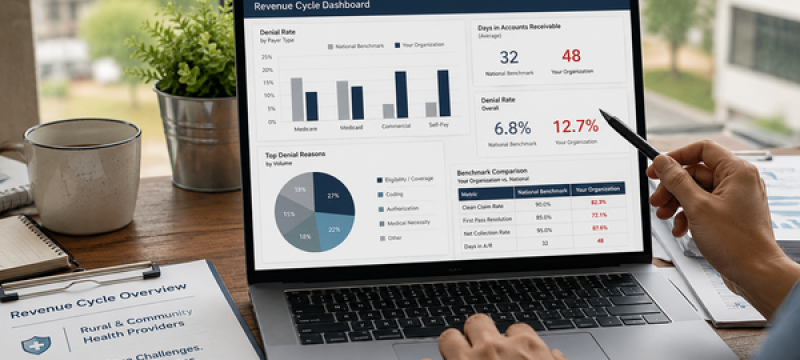
Denials are at the top of the list of healthcare’s revenue cycle problems. A January 2026 MGMA Stat poll of medical group practice leaders found denials and appeals are the single biggest source of revenue cycle leakage, cited by 48 percent of respondents, more than front-end issues, billing and collections, and coding combined.[1] That tracks with MGMA’s broader benchmarking work, which found more than half of U.S. healthcare organizations now report denial rates exceeding 10 percent, with appeals ranking among the most resource-intensive revenue cycle functions.[2]
For hospital and health system CFOs, that finding is a wake-up call. For billing directors at Federally Qualified Health Centers (FQHCs), Rural Health Clinics (RHCs), Critical Access Hospitals (CAHs), Rural Emergency Hospitals (REHs), and tribal health programs, it should read as familiar territory with a warning label attached. The national data capture a real and worsening problem, but were gathered largely from hospitals and health systems with resources (dedicated denial-prevention analysts, enterprise automation budgets, deep accounts receivable reserves) that most safety-net facilities simply do not have. Understanding where that gap lies and what it means operationally matters more to rural and community health billing leaders than the headline numbers themselves.
Key Takeaways • Denials are now the #1 revenue-cycle concern industry-wide, but national benchmarks are based on hospital and health-system data. • FQHCs and RHCs are reimbursed under cost-based, encounter-rate models (PPS/AIR): a denial pattern can distort next year’s per-visit rate, not just the current claim. • Thin billing staff at safety-net facilities can’t absorb rework growth the way large systems can. • Sliding-fee documentation already required of FQHCs can reduce compliance-related denials, if it’s captured in the billing system, not just on paper. • Meaningful denial prevention doesn’t require enterprise automation budgets. Disciplined front-end workflows close much of the same gap.
Denials Are Now Healthcare’s Top Revenue Cycle Challenge
According to MGMA’s 2024 benchmarking work, more than half of U.S. healthcare organizations report denial rates exceeding 10 percent, with appeals ranking among the most resource-intensive revenue cycle functions.[2] The American Hospital Association estimates that hospitals and health systems spent nearly $20 billion in a single recent year just trying to overturn denied claims, and while more than half of those denials were ultimately paid, it typically took multiple, costly rounds of appeals to get there.[3]
Those numbers describe a genuine industry-wide shift from reactive appeal cycles toward proactive, predictive denial prevention. The Deloitte Center for Health Solutions reported in 2024 that automated claim-scrubbing and predictive validation tools can prevent up to 85 percent of avoidable denials while reducing administrative cost per claim by nearly a quarter.[4]
Read at face value, the prescription looks straightforward: invest in predictive analytics, automate front-end data validation, and let AI-enabled workflows catch errors before claims reach the payer. For a 500-bed health system with a dedicated revenue integrity department, that prescription is achievable. For a 12-provider FQHC running lean administrative staff across three counties, it is a different conversation entirely.
Why the National Numbers Tell an Incomplete Story for Safety-Net Facilities
Three structural differences separate rural and community health billing from the hospital-system environment these benchmark reports describe.
A Denial Isn’t Just a Line Item: It’s a Rate-Setting Input
Most hospital denial benchmarks assume fee-for-service billing, in which a denied claim means lost revenue for that specific encounter and nothing more. FQHCs and RHCs operate differently. Medicare pays FQHCs under a Prospective Payment System (PPS) built on a national encounter-based rate, while Medicaid programs in many states still reconcile payments against an All-Inclusive Rate (AIR) tied to allowable costs divided by total visits, settled annually through cost report reconciliation.[5] A pattern of denials at an FQHC or RHC doesn’t only cost the revenue from those specific encounters. It can distort the visit and cost data that feeds next year’s per-visit rate calculation. National benchmark reports built around commercial fee-for-service denial patterns don’t account for that downstream effect, and it’s one of the clearest reasons a “typical” denial rate means something different at a cost-based safety-net facility than it does at a hospital paid under standard DRG or fee-schedule methodology.
Thin Billing Staff Have No Room to Absorb Rework Growth
Expanding audit activity and staffing shortages are compounding pressures alongside rising denials industry-wide. Large health systems facing that combination can shift staff, contract temporary coders, or lean on enterprise automation to absorb the additional workload. Most FQHCs, RHCs, and CAHs run billing departments staffed by a handful of people who handle coding, claims submission, denial follow-up, credentialing, and patient billing simultaneously. When denial volume climbs, there’s no deep bench to reassign. The same small team either works through the backlog on top of everything else or lets accounts receivable age. That staffing reality, not the raw denial percentage, is often the real constraint safety-net billing leaders are managing against.
Documentation Practices Already Built Into the Mission Can Become an Advantage (If They’re Captured Correctly)
Not every difference cuts against safety-net facilities. The American Hospital Association’s (AHA) 2024 “Patient Financial Communication and Compliance Report” found that hospitals with consistent financial-assistance documentation experienced 40 percent fewer compliance-related denials.[6] FQHCs are required to offer sliding-fee scales and treat patients regardless of ability to pay, which means financial-assistance documentation is already embedded in intake workflows at most health centers, a structural head start that hospital systems have to build from scratch. The advantage only materializes, though, if that documentation is captured consistently and coded correctly at the point of service. A sliding-fee determination stored in a paper file rather than in the billing system does nothing to prevent a compliance-related denial down the line.
What Prevention Looks Like Without an Enterprise Automation Budget
The shift from reactive appeals to proactive prevention doesn’t require the same set of tools across organizations to deliver value. A Becker’s Hospital Review survey found that systems leveraging automation reported 30 percent higher productivity and 20 percent lower turnover in patient financial services, gains driven less by software sophistication and more by removing repetitive, error-prone manual steps from staff workflows.[7] For a resource-constrained billing team, the same underlying principle applies at a smaller scale: front-end eligibility verification before the visit, standardized coding checklists for high-denial service lines, and disciplined tracking of prior authorization and telehealth modifier requirements can close much of the same gap that enterprise predictive analytics closes for larger systems, without the enterprise price tag.
Appeals still matter, and getting smarter about them compounds over time. The Journal of AHIMA reports that hospitals using feedback-driven appeals, where each denial outcome informs the next submission, shortened resolution times by 28 percent while improving claim accuracy across service lines.[8] That feedback loop is arguably more valuable for a small FQHC billing team than for a large health system, because a handful of recurring denial patterns typically account for the majority of a health center’s rework. Identifying and correcting those patterns at the source has an outsized effect when the denominator of total claims is smaller. For a closer look at where those patterns tend to originate, see Why FQHC Denial Rates Are Rising — And What Your Billing Team Can Do About It.
Watching the Regulatory Pipeline, Not Just the Payer Pipeline
National denial reports focus almost entirely on payer behavior: prior authorization requirements, documentation standards, coding edits. Safety-net facilities face an added layer: regulatory and coding transitions specific to cost-based reimbursement settings, from encounter code updates to telehealth billing rules for RHCs and FQHCs, that create denial spikes the general hospital-focused benchmarks never anticipate. Tracking those transitions before they take effect, rather than discovering them through a wave of denials after the fact, is a rural- and community-health-specific discipline that doesn’t show up in national survey data at all.
CPa Medical Billing’s Perspective
CPa Medical Billing (CPaMB), a GeBBS Healthcare company, has worked exclusively with FQHCs, RHCs, CAHs, tribal health programs, and other safety-net providers since 2003. That focus means denial management conversations start with reimbursement structures (PPS, AIR, cost report reconciliation) and the staffing realities that shape rural and community health billing, rather than retrofitting hospital-system benchmarks onto a very different operating environment.
Frequently Asked Questions
Why do national denial rate benchmarks understate the problem for FQHCs and RHCs? Most large-scale industry surveys and MGMA’s own benchmarking data draw primarily on hospital and health system or general practice respondents that bill under fee-for-service or DRG-based methodologies.[2] FQHCs and RHCs operate under cost-based, encounter-rate reimbursement where denials affect annual rate-setting, not just individual claim revenue, a dynamic the national data doesn’t isolate.
How does PPS or AIR reimbursement change what a denied claim actually costs a health center? Under FQHC PPS and RHC AIR methodologies, Medicare and many state Medicaid programs reconcile payments against visit and cost data reported annually.[5] A pattern of denials can skew the underlying data, affecting the calculated per-visit rate for the following year, as well as causing an immediate loss of revenue.
Can safety-net facilities use the same denial-prevention technology as large health systems? Enterprise predictive analytics platforms exist, but most FQHCs and RHCs achieve meaningful denial reduction through disciplined front-end workflows (eligibility verification, coding checklists, and prior authorization tracking) rather than large automation investments, capturing much of the same benefit at a fraction of the cost.
What 2026 denial trends should FQHC, RHC, and CAH billing leaders watch most closely? Coding and encounter rule transitions specific to cost-based settings, including telehealth billing changes and revised encounter codes, tend to create denial spikes that general hospital-focused benchmark reports don’t flag in advance, making regulatory tracking a distinct discipline for safety-net billing teams.
Where should a resource-constrained billing team start if denials are rising? Identifying the two or three recurring reasons for denial driving the majority of rework and correcting the root cause at the point of intake or coding typically delivers a faster return than broad technology investments for smaller billing departments.
Sources
[1] MGMA Stat poll (Jan. 6, 2026), “Detecting and fixing leaks across the revenue cycle.” mgma.com
[2] Medical Group Management Association, 2024 benchmarking data on denial rates and appeals; see also MGMA Stat, “Strategic Improvements in Your RCM to Reduce Your Practice’s Claim Denials,” March 2024. mgma.com
[3] American Hospital Association, “Payer Denial Tactics — How to Confront a $20 Billion Problem,” AHA Center for Health Innovation, April 2024. aha.org
[4] Deloitte Center for Health Solutions, “Healthcare Revenue Cycle Reinvention,” 2024.
[5] Centers for Medicare & Medicaid Services, “Implementation of a Prospective Payment System (PPS) for Federally Qualified Health Centers (FQHCs),” Transmittal 1383, May 2014. cms.gov
[6] American Hospital Association, Patient Financial Communications Best Practices and related financial-assistance documentation guidance. aha.org
[7] Becker’s Hospital Review, revenue cycle automation coverage, 2024.
[8] Journal of AHIMA, feedback-driven appeals and denial resolution coverage, 2024.